AI Agent Core Decision Flow & Prompt Cache Protection
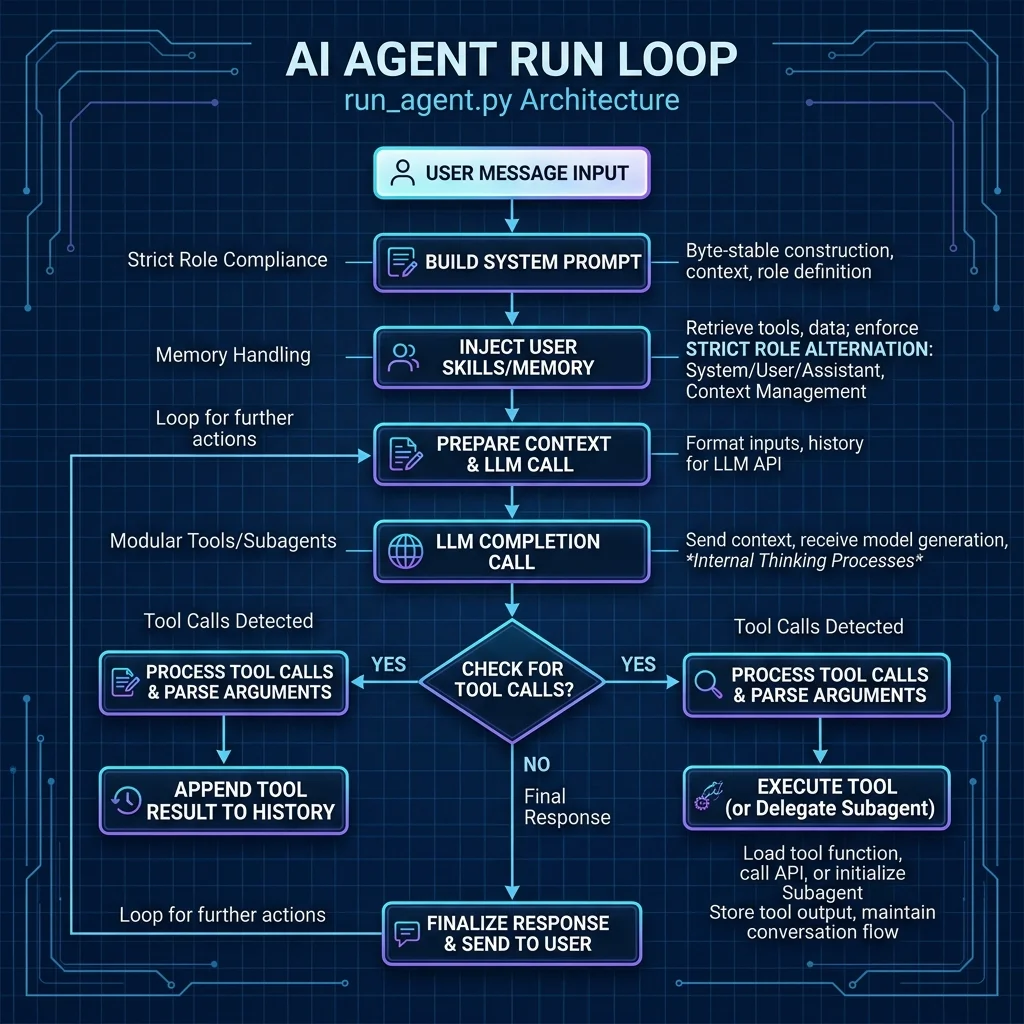
🧠 1. AIAgent Core Configuration & Lifecycle Control
The main brain AIAgent class is defined in run_agent.py. Its __init__ constructor contains several parameters. Beginners should focus on these core configuration properties:
max_iterations(default90): Controls the maximum number of tool-calling iterations within a single Turn. Reaching this value forcibly terminates the loop to prevent infinite loops.iteration_budget: Defines the token computation budget for this request (including input, output, and thinking). Once exhausted, all further LLM requests are denied.provider&model: Specifies the inference backend for the current session (e.g.openai,anthropic,deepseek) and the specific model name.enabled_toolsets: Tool whitelist. Only tools in this list are visible and dispatchable to the LLM._budget_grace_call(boolean): The "grace call" flag for graceful exit. When the token budget is exhausted during tool execution, the system reserves one final single-Turn interaction, allowing the LLM to output a proper response to the user.
🔄 run_conversation Session Loop Deep Dive
Each time a user sends a message, the system invokes AIAgent.run_conversation(). This loop runs on top of agent/conversation_loop.py:
# run_conversation pseudo-code
def run_conversation(self, user_message, ...):
    # Step 1: Load session history from DB, build System Message & Caching anchor
    messages = self._prepare_session_history(user_message)

    while api_call_count < self.max_iterations and self.iteration_budget.remaining > 0:
        # Step 2: Send request to LLM
        response = self.client.chat.completions.create(
            model=self.model, messages=messages, tools=self.get_tool_schemas()
        )

        # Step 3: If LLM gives a direct reply, exit
        if not response.tool_calls:
            self._save_to_db(response.content)
            return response.content

        # Step 4: Intercept and serially dispatch tool_calls
        for tool_call in response.tool_calls:
            result = self.handle_function_call(tool_call.name, tool_call.args)
            messages.append(self.format_tool_result_message(tool_call.id, result))

        api_call_count += 1
🔒 2. Prompt Cache Protection (Three Cache Invariant Rules)
To prevent cache misses that cause high latency and double token billing, Hermes employs three defense mechanisms to lock down the stability of the cached prefix:
🛡️ Rule One: Byte-stable System Prompt (Ordered JSON Schema)
In agent/system_prompt.py's format_tools_for_system_message(), every time tool schemas are assembled into the System Prompt, the system never uses unordered Python dicts but instead performs strict ascending sort and removes indentation whitespace:
# Byte-level stable prompt implementation
def format_tools_for_system_message(tools_list: list) -> str:
    # Force sort to avoid byte-stream changes from Python dict hash randomization
    sorted_tools = sorted(tools_list, key=lambda x: x["name"])
    return json.dumps(sorted_tools, sort_keys=True, separators=(',', ':'))
🔄 Rule Two: Strict Role Alternation Control
Some LLM providers are strict about role alternation in the message queue. If developers accidentally insert two consecutive user messages via Skills or Plugins, or place a tool message in the wrong sequence, the server will reject the request. In agent/agent_runtime_helpers.py, the system automatically inspects and repairs the message history: consecutive user messages are merged at the text level via newline joining; missing assistant responses before tool results are remedied by inserting a synthesized blank reply.
🚫 Rule Three: No Dynamic System Prompt Injection
Any system metadata containing dynamic timestamps (e.g., "Current time is 10:21:55"), runtime load, or transient paths must not be injected into the System Prompt header. These dynamic values instantly invalidate the cache. Hermes requires all such dynamic values to be provided as user messages or as tool call return values (e.g. get_system_time()), ensuring the System Prompt byte sequence remains pristine.
📉 3. Adaptive Trajectory Compression (Context Compaction)
As turns accumulate, session token counts grow rapidly. To prevent context overflow and reduce caching overhead, the system implements a compression algorithm in agent/conversation_compression.py. The process is driven by the following timing:
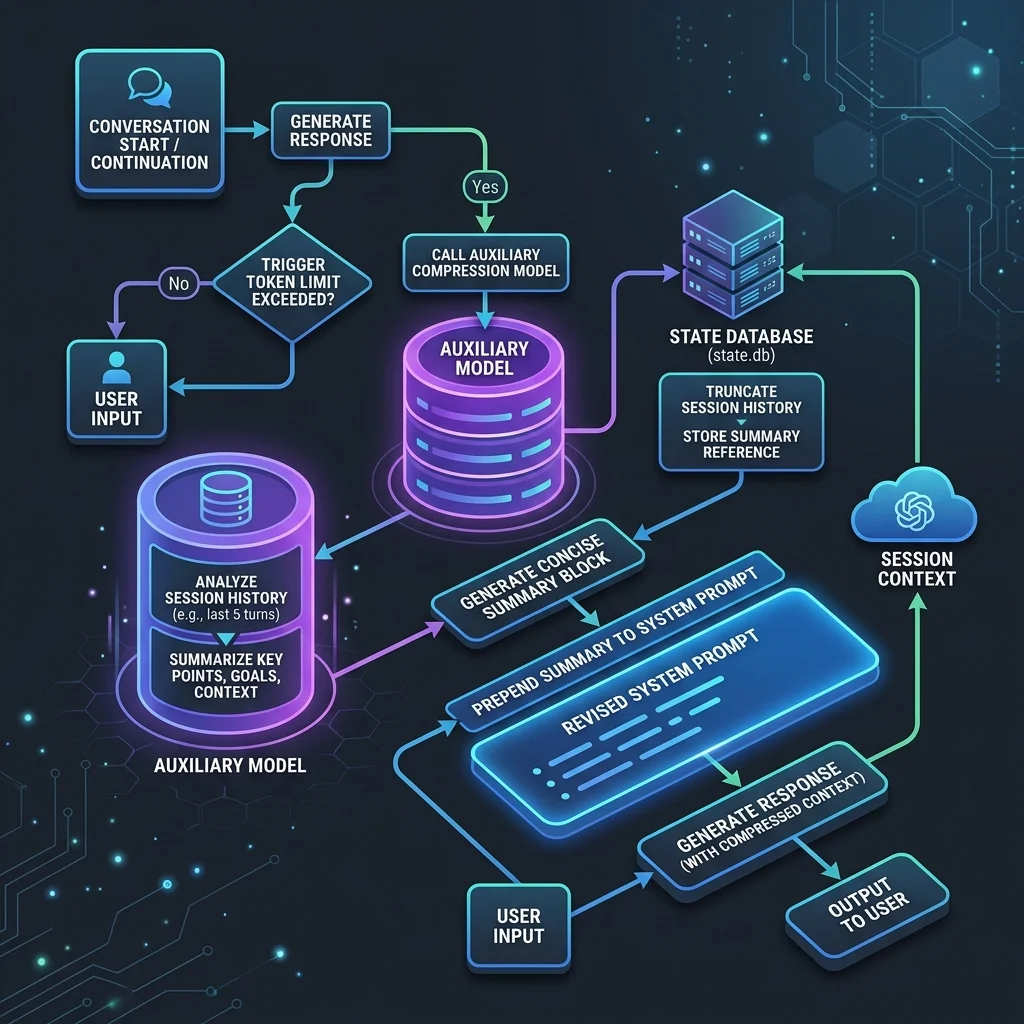
- Trigger Threshold: When the session token count reaches the LLM window's
threshold_percent, the main loop automatically triggers the compression phase. - Compression & Summary Generation: The system calls the auxiliary model specified by
auxiliary.compression.model, feeding it the historical turns slated for removal. It produces a concise Markdown-formatSummaryblock. - System Prompt Header Concatenation: The Summary is inserted into a fixed anchor position at the top of the system prompt:
[Historical Summary] {Summary} [End of Historical Summary] - Database Session Truncation: Before starting a new session, the system splits old history, deletes the summarized intermediate turns from the database, and retains only the most recent tail messages in memory and
state.db, dramatically reducing time-to-first-token latency.
🤝 4. Multi-Agent Dispatch & Concurrency Truncation Protection
When large tasks are decomposed, AIAgent may decide to invoke delegate_task within a Turn. This process includes the following critical paths:
- Dispatch Path: In
run_agent.py, the_dispatch_delegate_taskmethod intercepts this action. Rather than executing as a simple Python function, it dynamically imports thedelegate_taskmodule fromtools/delegate_tool.pyand spawns a newAIAgentthread for the subtask. - Sub-Agent Throttling & Deadlock Prevention (
_cap_delegate_task_calls): To prevent the model from spawning a storm of parallel sub-agents and causing runaway costs, the system inrun_agent.py's_cap_delegate_task_calls()forcibly cleans thetool_callslist:# Concurrency truncation delegate_count = sum(1 for tc in tool_calls if tc.function.name == "delegate_task") if delegate_count > MAX_CONCURRENT_CHILDREN: # Forcibly truncate excess sub-agent calls; extra calls are dropped and rescheduled in subsequent turns tool_calls = [tc for tc in tool_calls if ...] logger.warning("Truncated excess delegate_task calls to enforce concurrency limits.") - Kanban Collaboration: Sub-agents register themselves in the project
plugins/kanban/state. The main agent can poll the kanban state to monitor sub-process execution and synthesize the final result.
🔗 Sub-topic Deep Dive Articles
For master-level understanding of the agent core, explore these sub-pages with line-by-line Python source code analysis:
- AI Agent Conversation Loop Decision (run_conversation loop & grace_call limits)
- Prompt Cache Stability Three Invariant Rules (System Prompt sort & Role alternation)
- Adaptive Trajectory Compression & Online Summarization (Summary block & state.db physical truncation)
- Credential Pool Multi-Key Health Rotation & Cooldown (credential_pool.py concurrent fault degradation)
- Error Multi-Dimension Classification & Moderation Filtering (error_classifier.py circuit breaker & self-healing)