SessionDB Storage & SQLite High-Concurrency Lock Self-Healing
💾 1. SQLite state.db Core Table Relationships & Foreign Key Design
Session state (such as Turn history messages, variable snapshots, and Kanban sub-task lifecycle) is uniformly persisted in SQLite (typically named state.db). The underlying data table topology is shown in the following ER diagram:
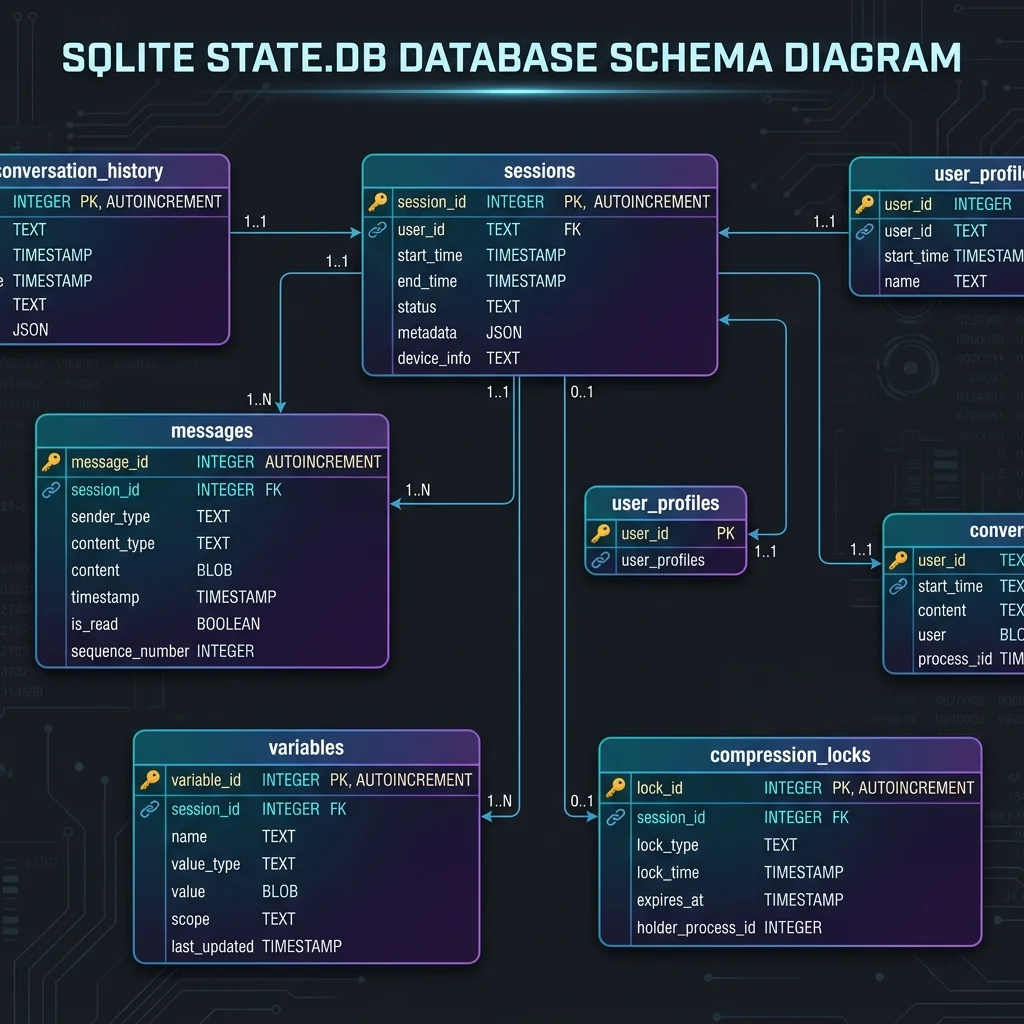
Core Table Responsibilities:
sessionstable: Main table. Stores session global state (e.g.,session_idPK,status,metadataJSON).messagestable: Stores the conversation tree. Itssession_idserves as an FK cascading to the main table. Each row stores the Turn role, content (BLOB), and unique sequence number.variablestable: Stores environment variables and snapshots bound during the session, providing context self-healing for background tasks and retries.compression_lockstable: High-concurrency conversation trajectory compression mutex table, ensuring that no two background threads compress the same session simultaneously.
☁️ 2. Network Filesystem WAL Compatibility Degradation (apply_wal_with_fallback)
If the user's project is deployed on NFS, SMB, WSL host virtual mount points, these environments often lack support for SQLite WAL mode's required shared memory mapping (.shm) and byte-range locks, which can throw:
sqlite3.OperationalError: locking protocol (or: not authorized)hermes_state.py:
# apply_wal_with_fallback implementation details
def apply_wal_with_fallback(conn: sqlite3.Connection, db_label: str) -> str:
    try:
        conn.execute("PRAGMA journal_mode=WAL")
        return "wal"
    except sqlite3.OperationalError as exc:
        msg = str(exc).lower()
        if any(marker in msg for marker in ("locking protocol", "not authorized")):
            # Automatically fall back to DELETE mode, disable shared memory mapping
            conn.execute("PRAGMA journal_mode=DELETE")
            _log_wal_fallback_once(db_label, exc)
            return "delete"
        raise
⏳ 3. Application-Layer Jitter Retry & Lock Convoy Avoidance
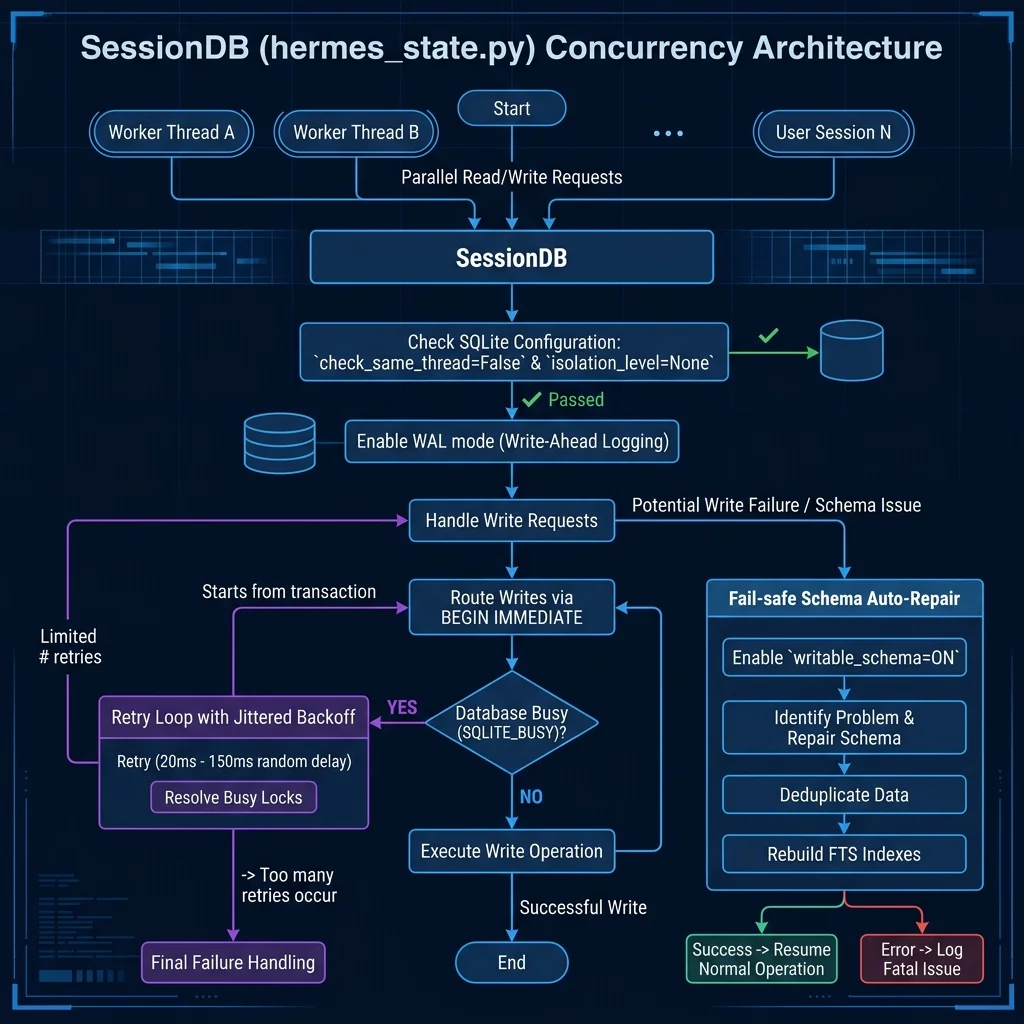
Regular SQLite retry mechanisms cause the "Convoy Pattern" — multiple blocked threads wake simultaneously to contend for the same lock, causing sustained database deadlock. Hermes uses application-layer random jitter in SessionDB to break the queue convoy:
- BEGIN IMMEDIATE Explicit Preemption:
Before executing any write SQL, the connection immediately declares
BEGIN IMMEDIATE. This intercepts SQLite write lock conflicts at the start of the transaction, preventing mid-transaction rollbacks. - Application-Layer Jitter (Random Backoff):
Once a
lockederror occurs, the code automatically releases the current Python thread lock and initiates a random sleep:# Jitter avoidance core logic _WRITE_RETRY_MIN_S = 0.020 # 20ms _WRITE_RETRY_MAX_S = 0.150 # 150ms # On lock conflict, release Python lock and sleep random time between 20ms-150ms to break convoy queuing jitter = random.uniform(_WRITE_RETRY_MIN_S, _WRITE_RETRY_MAX_S) time.sleep(jitter)
🔧 4. sqlite_master Schema Corruption In-Flight Direct Surgery
Under extreme circumstances, the sqlite_master metadata table can develop anomalous primary key conflicts, leaving ordinary developers helpless. Hermes encapsulates an in-flight repair surgery inside SessionDB:
- Exclusive Self-Heal Lock (
_repair_attempt_lock): Ensures no other concurrent background thread can read/write the DB block during repair. - Writable Schema PRAGMA Write:
# PRAGMA force repair schema
conn.execute("PRAGMA writable_schema=ON")
# 1. Attempt Strategy 1: Execute dedup surgery, keep only the lowest rowid original definition
conn.execute("""
    DELETE FROM sqlite_master
    WHERE rowid NOT IN (
        SELECT MIN(rowid) FROM sqlite_master GROUP BY type, name
    )
""")
# 2. If corruption persists, execute Strategy 2: Directly force-clear FTS virtual table metadata
conn.execute("DELETE FROM sqlite_master WHERE name LIKE 'messages_fts%'")
conn.execute("PRAGMA writable_schema=OFF")
🔗 Sub-topic Deep Dive Articles
For master-level understanding of SessionDB, explore these sub-pages: