Isolation Layer: Virtual Terminal Sandbox & Execution Environment Security Boundaries
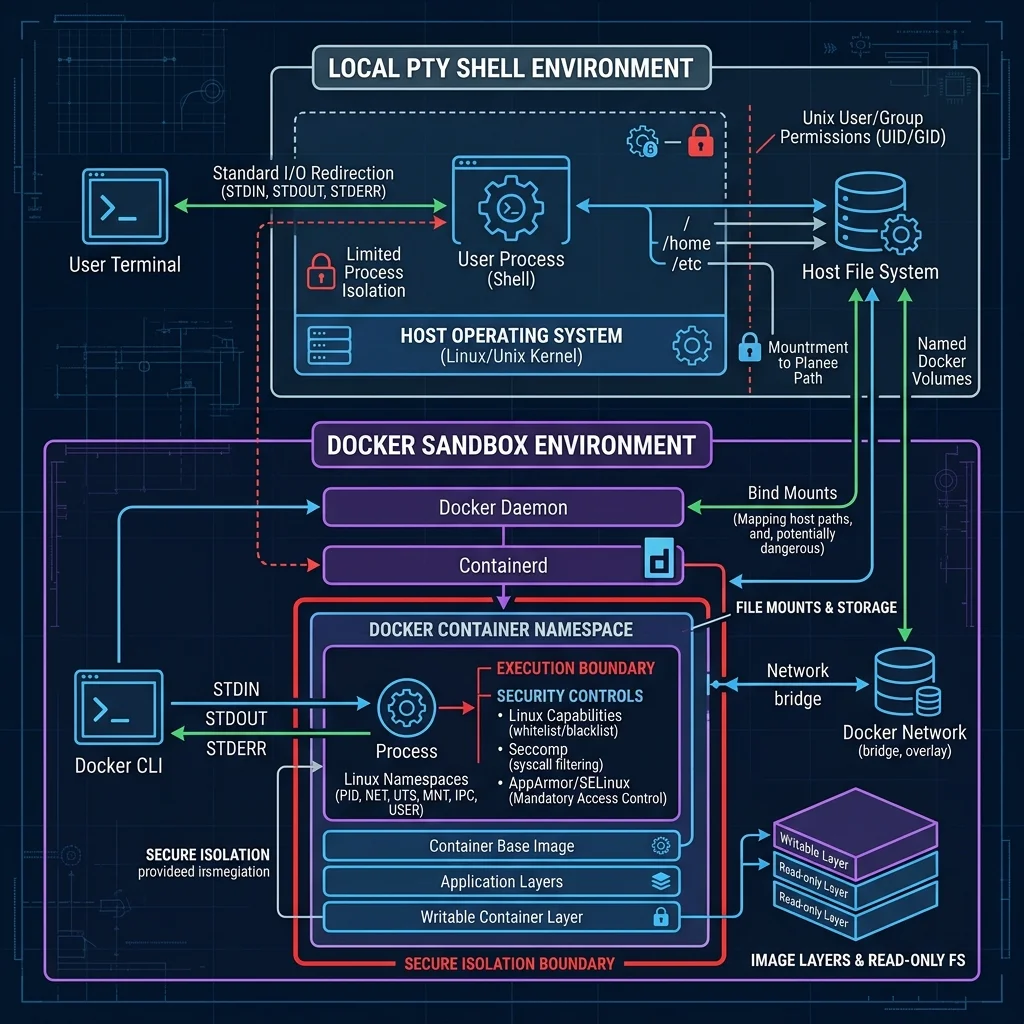
💻 1. Execution Environment (Environments) Responsibility Design
When designing environments where the agent can run shell scripts and code, security is the overriding prerequisite. In the project tools/environments/, the system wraps execution environments with a unified interface:
- tools/environments/local.py: Local execution environment. Implements pseudo-terminal redirection based on Unix PTY.
- tools/environments/docker.py: Container-based isolated sandbox. Confines all commands executed by the LLM inside a read-only, highly-restricted Docker container.
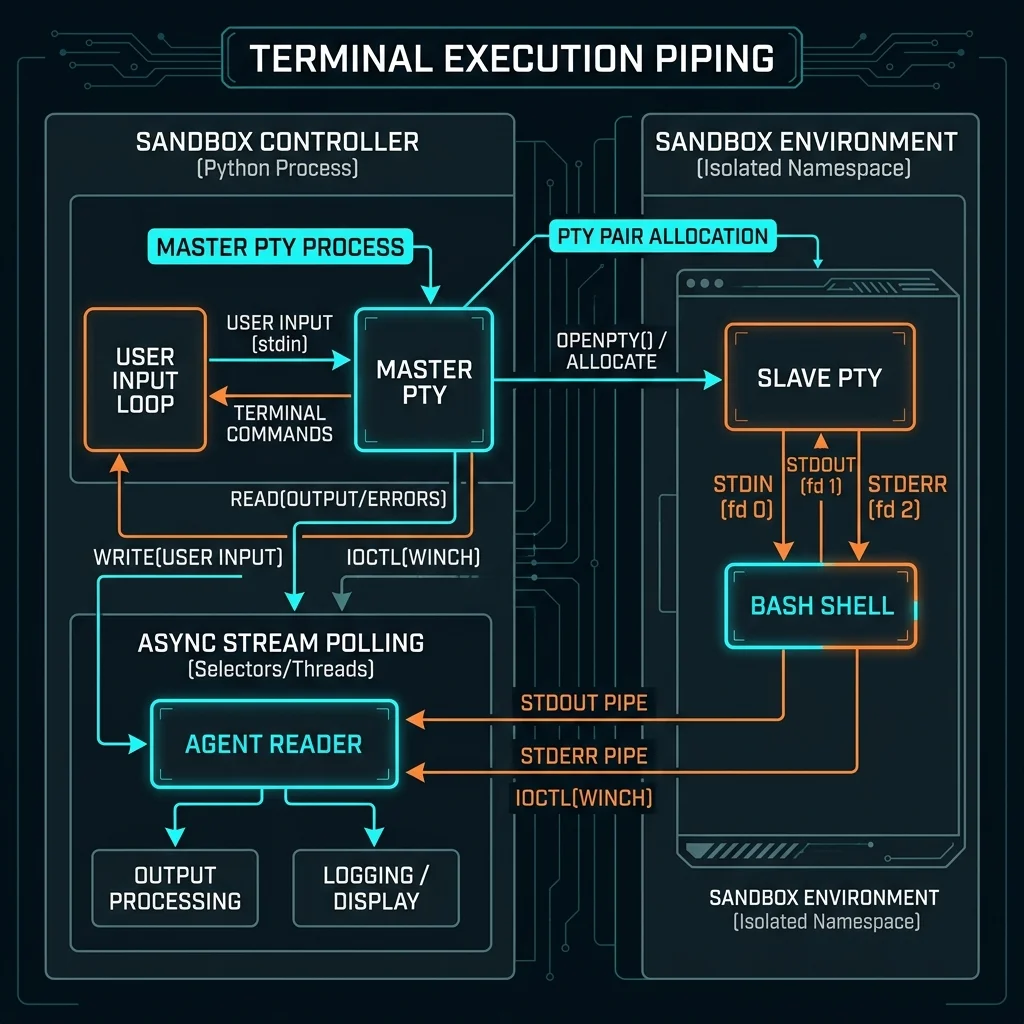
🔒 2. Local PTY Pseudo-Terminal Redirection & Control (local.py)
If the agent directly called Python's subprocess.Popen to start a terminal, the LLM would be unable to interact (e.g., typing confirmations in the terminal or streaming top logs). To solve this, tools/environments/local.py implements low-level Unix PTY control:
- pty.openpty() Interface: Creates a pseudo-terminal pair (Master and Slave devices) in the background, redirecting stdin, stdout, and stderr to the PTY slave device.
- Streaming Listener & Hard Timeout: A background daemon thread monitors the Master output, pumps characters to the gateway and TUI frontend in real-time, while enforcing a hard timeout threshold. If no response is received within the limit, it sends a
SIGKILLto force disconnection, completely eliminating zombie processes.
🛡️ 3. Docker Container Isolation & Security Boundary (docker.py)
For remote deployment or high-risk scenarios (such as auditing third-party downloaded scripts), local PTY can severely compromise host security. In tools/environments/docker.py, the system uses Docker containers to build a fully physically isolated sandbox defense:
- Read-Only Volume Mount:
The system mounts only the current Workspace as a read-only disk into the container, preventing the LLM from tampering with system files (e.g.,
/etc,/lib). - Namespace Isolation:
When launching the container, it enforces independent
PID,NET,IPC, andUTSnamespaces. The LLM inside the container has no ability to probe the host's network or process topology. - Security Filtering Mechanism:
The container injects strict
security_optssecurity attributes at startup, restricts Linux Capabilities (blocking most root system calls), and mounts Seccomp and AppArmor policies to ensure the sandbox is impenetrable.
🔗 Sub-Chapter Deep Dives
For a deeper understanding of virtual sandboxes and PTY interaction, we recommend the following technical sub-topics: